

For local councils across Australia and New Zealand, the “silver tsunami” of retiring staff represents a critical threat to essential services in water infrastructure management. Decades of operational knowledge, often held by a handful of long-serving employees, are at risk of being lost. This isn’t just a challenge for water management; it impacts all council services that rely on field and operational teams, from waste management and road maintenance to parks and facilities. AI provides a powerful solution, not just by automating tasks but by creating a digital co-pilot that empowers the entire workforce and preserves institutional knowledge.
The Challenge: More Than Just Water
Smaller councils, in particular, face immense pressure. They often have limited budgets, smaller teams, and a vast range of responsibilities. An aging workforce is a significant issue, as finding skilled replacements in regional or remote areas can be incredibly difficult. When a senior staff member retires, they often take with them a wealth of information—everything from the location of a tricky valve to the best way to handle a specific type of maintenance or repair. This reliance on “tribal knowledge” creates a single point of failure and makes it challenging to train new employees effectively.
The solution needs to address this core problem across all council services. It must be accessible, easy to use, and capable of integrating information from multiple departments.
AI as Your Digital Co-Pilot
Teamsolve’s platform offers a solution that’s tailor-made for this council context. The concept of a digital knowledge twin is a game-changer. It’s a virtual replica of your council’s operational knowledge base, but unlike a static database, it’s alive and conversational. It captures information from multiple sources—maintenance logs, sensor data, expert insights—and makes it instantly accessible through familiar platforms like WhatsApp or Microsoft Teams.
This reliance on “tribal knowledge” creates a single point of failure and makes it challenging to train new employees effectively.
Think of it this way: a parks and recreation officer could ask, “What’s the best fertiliser for the rose bushes at Memorial Park?” and the digital twin would provide an answer based on historical records, soil data, and best practices. A road maintenance crew could query, “What’s the correct bitumen mix for repairing a pothole on a high-traffic road?” and receive a step-by-step guide. This isn’t just about water; it’s about providing a unified, intelligent resource for every operational team.
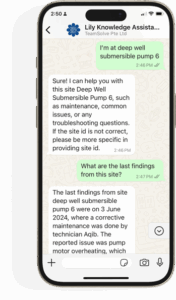
The benefits of this approach are profound:
- Preserving Institutional Knowledge: The platform actively captures and digitizes the wisdom of experienced employees. As senior staff members document their processes and share insights, this information becomes part of the digital twin, ensuring it’s not lost when they retire.
- Empowering the Next Generation: New employees can learn on the job with an intelligent guide. Instead of waiting for a supervisor, they can access instant, accurate information, reducing training time and improving on-site decision-making.
- Streamlining Operations: By consolidating information from various departments, the digital twin breaks down traditional silos. A water operations team can access data that might be relevant to a road maintenance project, fostering greater collaboration and efficiency.
A Comprehensive Solution for Councils
Teamsolve’s Lily is more than just a water utility tool. It’s designed to manage the full spectrum of council operations. For a small council with limited resources, this is invaluable. Instead of investing in separate, expensive software for each department, they can use a single, unified platform. Lily can help with:
- Water and Wastewater Management: Optimising pump schedules, predicting maintenance needs, and providing real-time data on water quality.
- Roads and Infrastructure: Tracking maintenance schedules, managing asset inventories, and providing guidance on repair procedures.
- Parks and Facilities: Managing irrigation systems, scheduling mowing and weeding, and providing staff with information on plant care and safety procedures.
- Waste Management: Optimising collection routes, tracking bin status, and managing a fleet of vehicles.
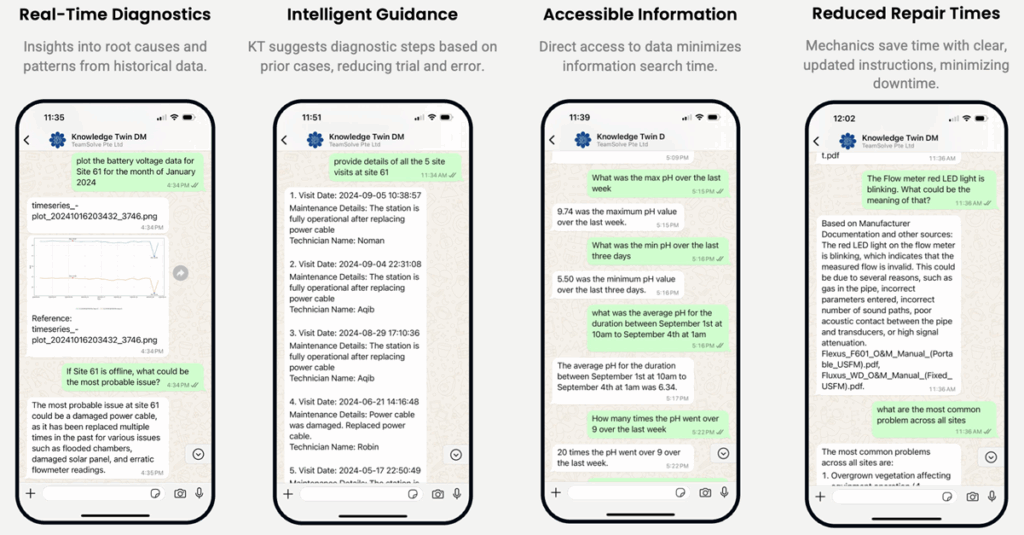
By integrating these services into one conversational platform, councils can achieve a level of operational efficiency previously only available to larger, better-funded organisations. This AI co-pilot approach doesn’t replace staff; it augments them, freeing up their time for more complex, high-value tasks and helping them make smarter decisions.
In a region grappling with workforce challenges and an urgent need for modernisation, platforms like Lily are more than just a tech upgrade—they are a strategic imperative for building resilient, efficient, and well-managed councils for the future.
Get in touch with us today to discuss our partnership with Teamsolve.