

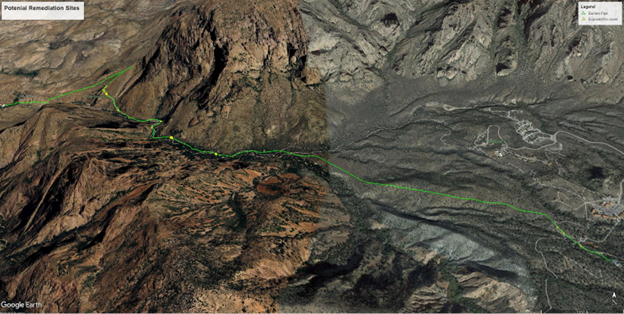
The National Park Service (NPS), in its continued efforts to preserve vital infrastructure within Big Bend National Park, Texas, recently commissioned a condition assessment of the Chisos Basin water supply system. Central to this project was a 4.8km (3 mile), 90mm (3.5-inch) galvanized steel pipeline – installed in 1955 – that delivers water from Oak Spring Pump Station to the Chisos Basin Water Plant.
To inform future rehabilitation plans and provide a clear understanding of asset health, the NPS engaged p-CAT™ Sonic, a proprietary acoustic pipeline inspection solution developed to assess pipe wall integrity without excavation or service interruption.
This case study highlights how the p-CAT™ Sonic technology provided precise sub-sectional data to help quantify remaining service life, identify vulnerabilities, and support long-term asset management. For utilities, councils, and consultants in Australia, New Zealand, and globally, this project demonstrates the power of non-invasive diagnostics to extend the service life of aging assets while preserving budget and operational continuity.
Technology Overview
p-CAT™ Sonic analyses the way controlled acoustic signals travel through water mains. Variations in these sound waves – detected by accelerometers or hydrophones – reveal pipe wall conditions such as thickness loss, corrosion, and structural changes. A portable pulse generator introduces a gentle vibration into the water column, while ultrasonic gauges verify wall thickness at test points. Unlike intrusive techniques, p-CAT™ Sonic requires no pipe shutdown or cutting, making it ideal for sensitive environments like national parks or urban centers.
Project Scope and Site Conditions
The subject pipeline is a coated steel feeder main constructed in 1955 using 6 meter (20-foot) threaded segments. Running across rugged terrain, the line includes over 600 meters of pipe exposed to the environment, with elevations and pressures reaching as high as 55 bar. Past assessments were conducted in 2002 and 2022, but both assumed inaccurate baseline material properties – leading to overly pessimistic conclusions regarding structural integrity and remaining service life.
p-CAT™ Sonic was tasked with:
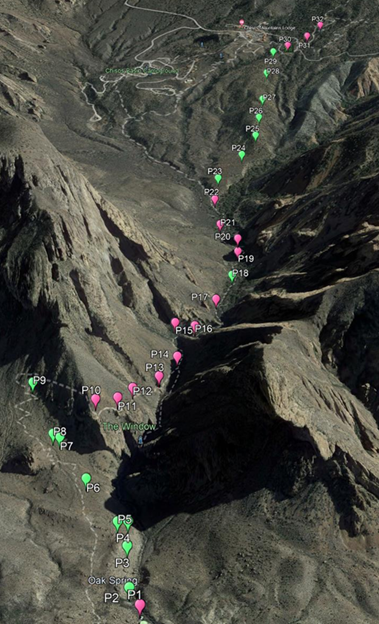
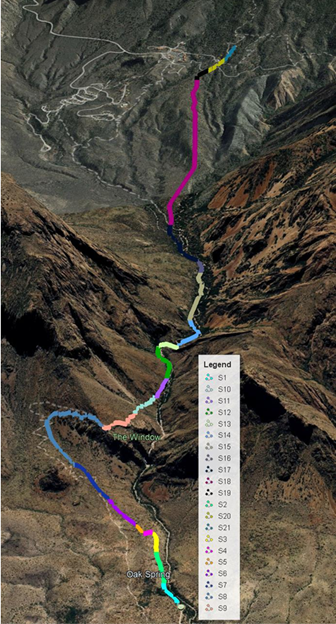
- Performing 35 sub-sectional assessments (17 of which required new excavations as the line has only 4 existing connections (gate valves at either end, plus an AARV at the top of a mount and a scouring valve at the low point)
- Confirming wall thickness via ultrasonic testing
- Cross-checking findings against historical data
- Estimating corrosion rates and remaining service life
- Updating GIS maps with accurate pipe locations and depths
- Conducting leak detection using advanced acoustic correlation
Findings and Field Insights
Despite the pipeline’s age, the PII inspection yielded reassuring results:
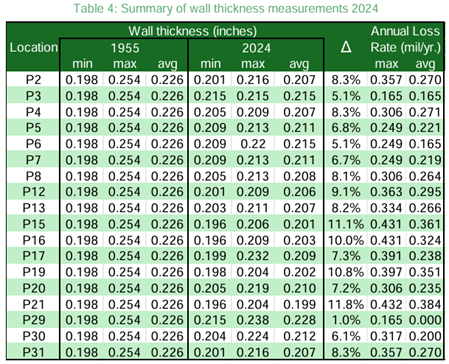
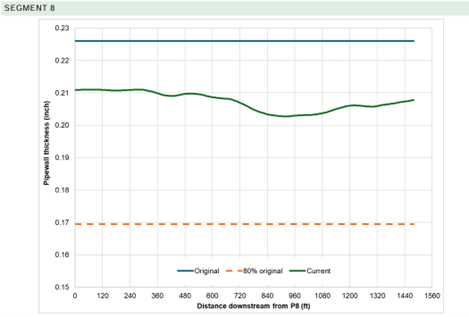
- Wall Thickness: Most tested segments retained over 86% of original wall thickness. The thinnest measured areas still held more than 80%, significantly above minimum structural thresholds.
- Corrosion: Minimal surface corrosion was observed. Apparent “rust” in exposed areas was superficial and easily removed. Nearly all material degradation was internal – likely due to partial loss of the internal coatings.
- Leak Detection: Real-time and post-processed leak correlation found no evidence of active leaks exceeding 4 l/min across all assessed segments.
- Historical Corrections: Manufacturer catalogs revealed the original steel grade and wall thickness to be stronger and thinner than previously assumed. This corrected past overestimations of degradation and yielded a more accurate, less pessimistic projection of remaining life.
One exposed section, located on a hiking path, was identified as being at slightly higher risk due to foot traffic and moisture exposure. It was recommended for surface cleaning, coating, and light concrete encasement to protect it from further deterioration.
Estimated Remaining Service Life
Using a linear degradation model based on verified wall thickness data, p-CAT™ Sonic estimated the following:
- Weakest segments: up to 40 years of remaining service life
- General pipeline length: 50+ years under current operating conditions
These projections offer the NPS peace of mind and a sound basis for planning phased rehabilitation, deterring costly replacements (>$30 million USD) while ensuring continued reliability.
Why It Matters
For water utilities and councils in Australia, New Zealand, and globally, this project illustrates how non-invasive acoustic technology like p-CAT™ Sonic can deliver data-rich insights into aging infrastructure. Traditional methods often over-rely on destructive sampling or broad assumptions. In contrast, p-CAT™ Sonic provides:
- Granular, sub-sectional condition profiles
- Verified degradation rates through time-series analysis
- Accurate forecasting of remaining service life
- GIS-integrated reporting for easier asset planning
Conclusion and Recommendations
The p-CAT™ Sonic inspection at Big Bend National Park has delivered a compelling demonstration of how modern condition assessment technologies can bridge the gap between asset uncertainty and confident long-term planning. No active leaks, minimal corrosion, and a clear maintenance roadmap mean that the Park Service can focus on proactive, rather than reactive, infrastructure management.
For utility asset managers, engineers, and consultants worldwide, p-CAT™ Sonic offers an unmatched combination of precision, efficiency, and non-invasiveness – empowering better decision-making while extending the operational life of buried pipelines.
Recommendation Summary:
- No urgent repairs required; revisit weakest segments in 3-4 years
- Apply surface protection to exposed pipe in high-risk zones
- Reassess if pressures or operating conditions change
- Leverage p-CAT™ Sonic and GIS data for future pipeline segments and planning